Hospitals and pharmaceutical labs across Europe are under pressure from two directions at once: rising regulated medical waste disposal costs and tighter environmental regulations that show no sign of easing.
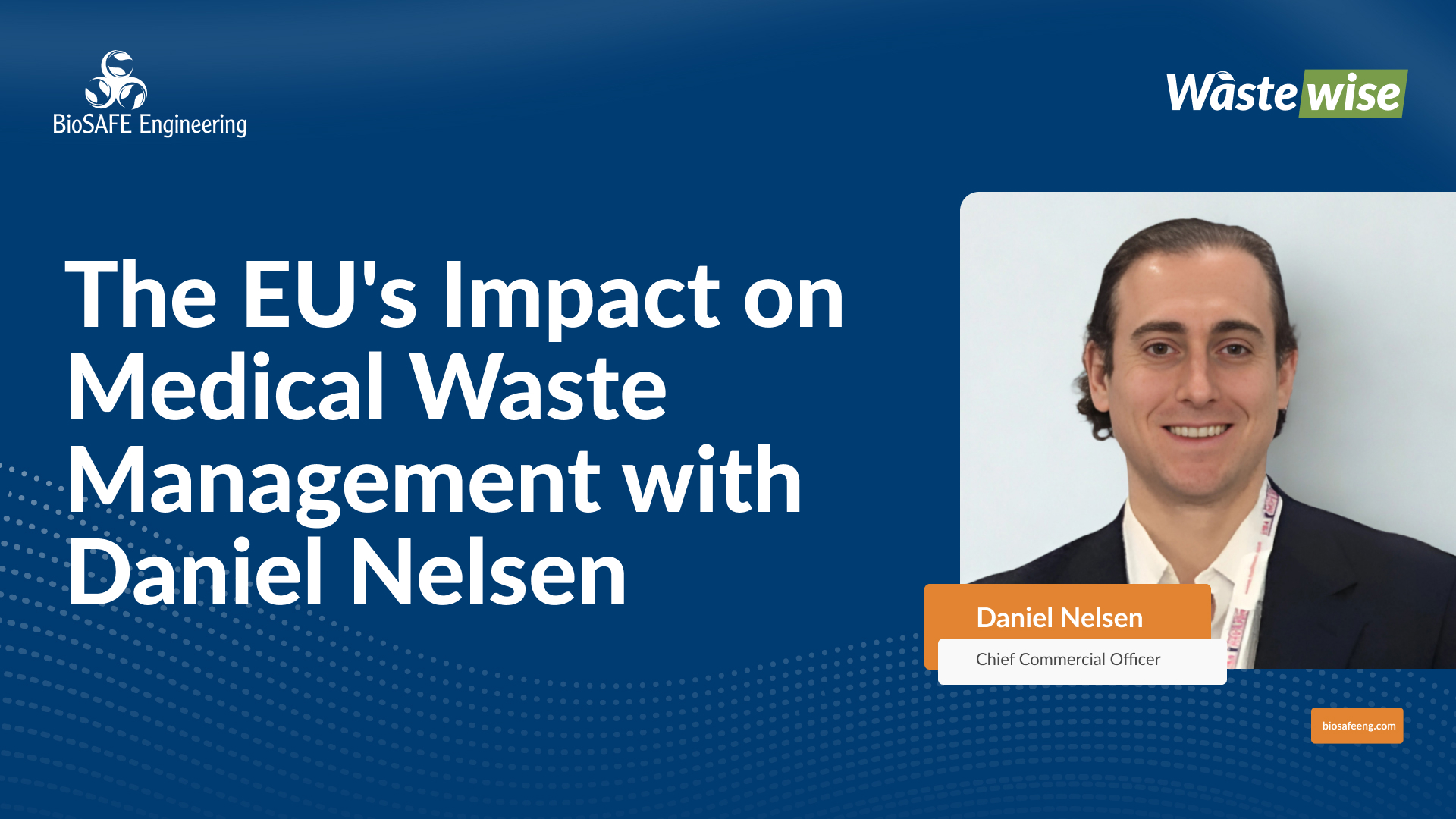
Incineration used to be the default method for handling infectious waste, but it’s no longer easy to justify. “Yes, you can incinerate,” said Daniel Nelsen, Chief Commercial Officer at BioSAFE, “but you have to install scrubbers that meet new requirements.” Over time, the cost of compliance made older systems harder to sustain.

Meanwhile, expectations are changing. It’s no longer enough to simply get rid of waste. Government agencies, investors, and internal sustainability teams now expect facilities to track emissions, recover recyclable material, and reduce what goes to landfill.
This article is designed to help operations leaders and sustainability managers build a business case for better solutions — ones that are safer, more efficient, and easier to defend during audits. It walks through key steps, from evaluating site-specific needs to demonstrating a clear return on investment.
Step 1: Understand the EU Regulatory Landscape for Medical Waste Disposal
Medical waste rules in the U.S. began to tighten after untreated materials started washing up on public beaches in the 1980s and 90s. Those events sparked public concern and led to stricter handling requirements for hospitals and labs.
Today, the focus has expanded beyond safety. In Europe, regulations such as the EU Packaging and Packaging Waste Regulation now require manufacturers to incorporate a minimum percentage of recycled plastic in their products — driving up demand and prices for clean, treated materials. For facilities generating significant plastic waste, this shifts the equation entirely. What was once a disposal problem might now be a recoverable asset.
In the U.S., regulated medical waste disposal is governed by both federal regulations and state’s regulations. While federal laws like the Resource Conservation and Recovery Act (RCRA) and specific sections of the Code of Federal Regulations (CFR) set standards for waste segregation, handling, and treatment, primary regulatory authority now rests with state environmental and health departments, as the federal Medical Waste Tracking Act expired in 1991. For example, York State, through the York State Department of Environmental Conservation, has established comprehensive regulations covering all aspects of handling, storage, treatment, and disposal of regulated medical waste.
Large healthcare and life sciences companies with global operations are also being asked to report more. “They’re having to take inventories of what they’re generating,” said Nelsen, “and face questions from public investors, EU member states, and other regulatory agencies.”
For many facilities, waste still shows up as a simple line item. But the reality is more complicated. It carries costs, introduces compliance risks, and — if handled differently — could create value.
Step 2: Inventory Your Waste Streams
Improving waste systems starts with better visibility. For most facilities, that means moving beyond general estimates and taking stock of what’s being generated by type, by volume, and by source. The material generated in healthcare and research settings includes biomedical waste, which is considered medical waste when it poses infectious or hazardous risks. About 15% of healthcare waste is considered regulated or hazardous, requiring strict handling to prevent disease and environmental damage.
“It’s really just incremental work,” said Nelsen. Most organizations “may start off with a very basic or very high level kind of overview or understanding of some of those more granular emissions or waste-related considerations.” Many begin with broad waste logs and slowly work toward identifying exactly what’s in the red bag — especially plastics that might be recyclable if appropriately treated.
This level of detail opens up new possibilities. If your team can isolate a common device or packaging type that, once decontaminated, qualifies as post-consumer recycled plastic, it might be worth more than the cost to haul it away.
To do the same, facilities should start documenting: types of waste (solid, liquid, and tissue), volume by process or department, and material composition and recyclability. Proper segregation of healthcare waste is essential; segregating non-infectious waste from regulated medical waste (RMW) can significantly reduce disposal costs for healthcare facilities. This kind of data helps teams calculate cost savings, resale value, and emissions reductions with more confidence — and gives them leverage when current practices look more expensive than they are effective.
Step 3: Evaluate On-Site Treatment Options for Regulated Medical Waste Disposal
Once you understand what your facility produces, you can start matching waste types to treatment methods that are safe, compliant, and financially sound. Regulated medical waste includes various categories such as pathological waste, microbiological waste, contaminated sharps, isolation waste, contaminated animal carcasses, and pharmaceutical waste.
- Effluent Decontamination Systems (EDS) sterilize liquid waste from labs, vivariums, and pharmaceutical production lines. Many BSL-3 and BSL-4 facilities are required to use EDS before releasing wastewater.
- Medical Waste Systems treats solid regulated waste onsite, such as red bag materials from clinical or lab settings. They eliminate the need for hauling or incineration and don’t rely on chemicals or combustion, which helps reduce compliance risks and long-term costs.
- Tissue Digesters use alkaline hydrolysis to break down biological or animal tissue. The output is a sterile liquid that can be safely discharged with the proper permits. These systems reduce handling risk and avoid the ash disposal associated with incineration.
All three systems help reduce cost and support compliance, but they also make material recovery more feasible. When the inputs are stable, building a system that works efficiently and pays off over time is much easier.
Step 4: Calculate the Cost Shifts and ROI
Once you’ve mapped out your waste streams and identified the right treatment options, the next step is understanding the financial impact. Regulated medical waste must be segregated at the point of origin into appropriate containers to ensure safety and compliance, which is essential for proper waste management and can also affect overall costs.
One area often overlooked is the value of treated materials. Many facilities send plastics straight to landfills, not realizing that if handled properly, those materials might qualify for resale. When you factor in recycling revenue, lower hauling costs, and fewer compliance risks, the economics can shift quickly.
Step 5: Align Internal Stakeholders
Even with clear numbers on cost and savings, waste treatment changes won’t stick unless the right people are on board. In most healthcare and lab settings, that means getting sustainability, procurement, operations, and finance involved from the start.
Nelsen noted that facilities can’t just switch packaging or handling procedures overnight. “Often, if you want to go that direction, you pull in someone from the device manufacturer, someone from a purchasing group, and someone else from a hospital association.” It takes cross-functional input to make meaningful changes, especially when they touch supply chains or regulated materials.
Many teams have found success by starting small. Rather than trying to change everything at once, they run pilot programs to test recovery methods, gather performance data, and work out the operational details.
Positioning the shift as a compliance safeguard and an operations win can help move things forward. When teams see that it lowers risk and makes day-to-day work easier, they are much more likely to buy in.
Step 6: Pilot, Measure, and Scale
Most facilities don’t roll out new waste systems all at once. A smaller pilot, focused on a single campus or specific waste stream, makes it easier to test ideas without disrupting daily operations.
Nelsen noted that teams often start broad, then narrow their focus year over year. They begin with simple tracking, then refine how they measure emissions, waste composition, and recycling potential as the program evolves.
To support expansion, it helps to track:
- How much waste is diverted from landfill
- How much is saved in disposal costs
- How much is recovered or recycled
Strong pilot data gives teams the evidence they need to make informed decisions about broader rollout based on results, not assumptions.
Conclusion
Over the past several years, medical waste management has evolved from a sustainability concern into a practical tool for reducing costs, improving efficiency, and meeting compliance obligations.
And there’s no need to wait for new regulations to get started. “There are increasingly cost-effective ways of handling and recovering valuable resources from what was previously viewed as a waste stream,” Nelsen explained.
The opportunity is clear for facilities that generate consistent waste volumes. With accurate data, a focused treatment strategy, and internal alignment, teams can shift from reactive compliance to proactive cost control and material recovery — and build a regulated medical waste disposal program that’s defensible, scalable, and measurable from day one.
Watch this WasteWise episode to hear more about the regulations driving change, how companies like Takeda are adapting, and what’s shaping the future of medical waste treatment.