
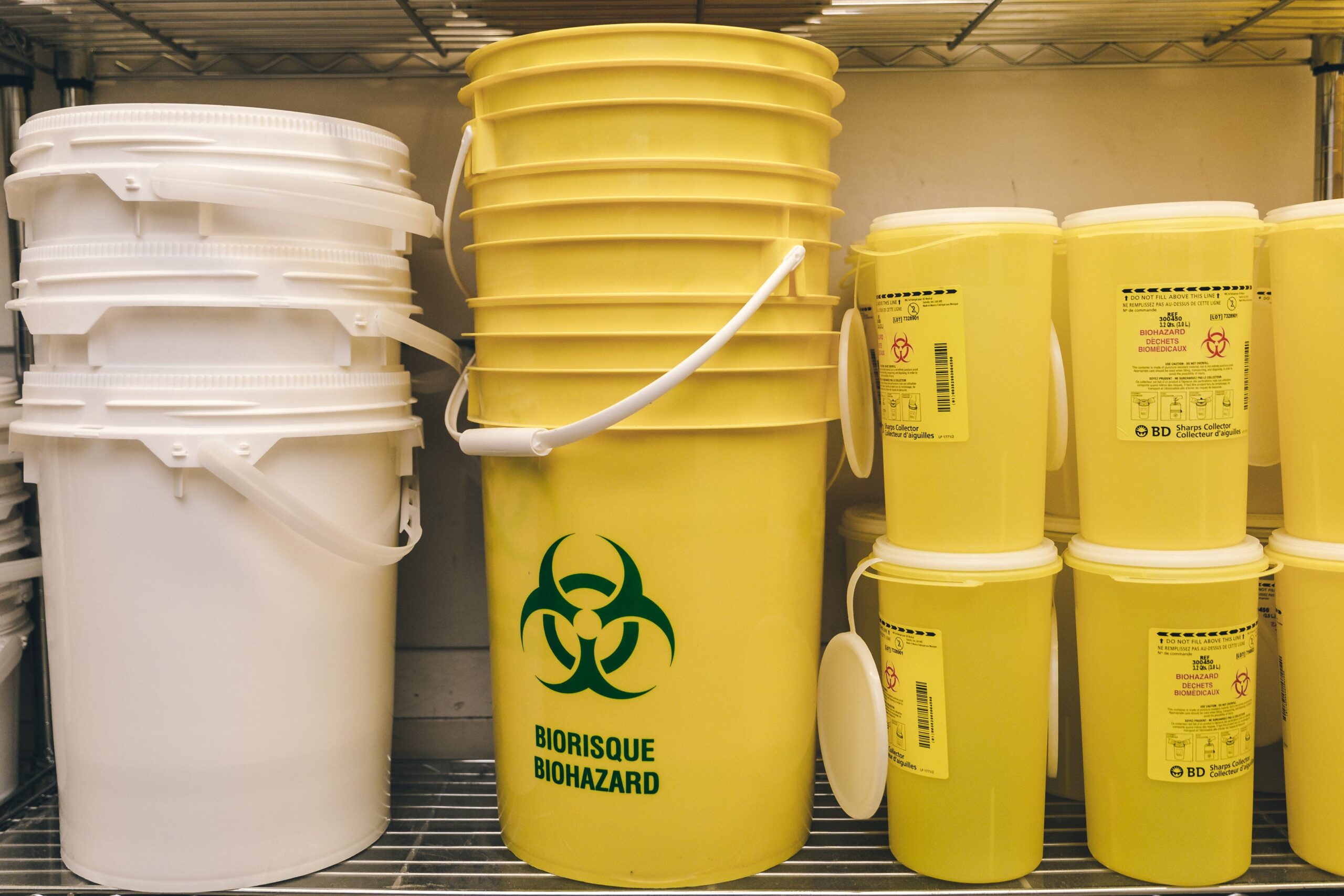
Bio waste shapes both safety outcomes and operating margins across healthcare and life science facilities. Vague definitions of biological, biohazard, or biomedical waste can trigger OSHA exposure risks and inflate disposal fees.
Effective medical waste management relies on clearly defining your waste streams, such as solid regulated waste, liquid effluent, and pathological tissue. Policies must align with state and DOT requirements to ensure containers, labels, and storage remain consistent from the point of use to the final chain of custody.
Strategic bio waste treatment decisions ultimately shape a facility’s bottom line and operational continuity. By implementing the right on-site treatment technologies, healthcare and life science leaders can ensure stringent compliance, unlock significant labor and operational efficiencies, and reduce their overall cost per pound.
What is bio waste (and why does the term get confusing)?
In day-to-day operations, bio waste refers to discarded material containing biological material. Some of these materials pose an infection risk and fall under regulated medical waste, while others remain non-regulated depending on exposure and facility policy. It arises from hospital diagnosis and treatment, or lab and biopharma test work, cultures, and process-contact items.
While medical waste encompasses everything from solid regulated waste to liquid effluent and pathological tissues, accurately defining your facility’s specific waste profile is a crucial first step for operations leaders.
Misunderstanding these streams complicates staff education, distorts waste totals, and creates downstream compliance risk. Clearly distinguishing your waste types is the first step toward matching each stream to the correct handling and treatment pathway.
- Biological Waste: Any material of biological origin, even if no infectious agent exists.
- Biohazard Waste: Signals a potential exposure hazard; usually aligns with regulated medical waste (RMW).
- Biomedical Waste: A legal term typically naming the regulated subset of waste from healthcare settings.
- Biowaste: Often refers to food scraps or yard organics for composting—not infectious waste.
Accurately identifying whether you are dealing with solid medical waste, liquid effluent, or pathological tissue ensures your facility can implement the exact on-site treatment system required.
Matching the right waste stream to the right technology is critical for compliance and operational efficiency. For many facilities, this evaluation includes comparing off-site disposal against on-site treatment options to determine the best balance of risk management, cost control, and operational continuity.
Why bio waste is regulated: History and drivers
In the late 20th century, high-profile incidents put medical waste in the public eye. Daniel Nelsen, Chief Commercial Officer at BioSAFE Engineering, notes that events involving “untreated hospital waste or medical waste washing up on public beaches” created a “public outcry” that built “support for the implementation of a series of regulations.” This period established strict definitions and treatment standards for infectious waste.
As life expectancy and procedure volumes grew, so did waste totals. More patient visits meant a higher volume of sharps, dressings, and pathological waste, and putting these larger volumes on third-party waste trucks increasingly exposed facilities to compliance violations and severe reputational risk.
This drove the need for more tightly controlled waste management strategies and increased scrutiny around how regulated medical waste is transported and treated.
Environmental and economic drivers
Healthcare also “transitioned to more single-use plastic devices, improving sterility,” as Daniel notes. While this reduced infection risk, it spiked biohazard waste volume and disposal demand.
Subsequently, air and water policies raised off-site incineration and hauling costs through strict requirements for scrubbers, stack tests, and ash disposal. Rather than banning practices, regulators added ‘cost layers’ to third-party disposal.
This fundamentally shifted the economics of medical waste, prompting many healthcare and life science facilities to evaluate on-site treatment as a way to gain greater operational control.
Bio waste categories used in medical waste management programs
Strong programs define their waste streams not just for compliance, but to determine the most cost-effective on-site treatment pathway. While EHS policies vary, most facilities categorize their waste into these core groups:
Core solid streams
- Potentially infectious solids: Items contaminated with blood or body fluids, such as PPE, gauze, drapes, swabs, and disposable devices. For hospitals and commercial processors, this high-volume stream represents a significant line item in the waste budget, and a strong candidate for cost recovery by moving treatment in-house.
- Sharps: Needles, scalpels, and contaminated glass. Because third-party haulers charge a premium for sharps disposal, these costs add up quickly. Facilities can reduce reliance on per-pound hauling fees by processing sharps alongside other regulated streams in-house using continuous-feed shredding and low-pressure steam technologies—transforming a high-cost liability into a managed internal process.
Specialized and escalated streams
- Cultures and stocks: Materials from research or diagnostic labs, including plates, flasks, and pipette tips. These often drive stricter treatment rules due to viable organisms.
- Pathological or anatomical waste: Human or animal tissues and body parts. Due to the high cost of third-party pathological waste hauling, advanced facilities are adopting engineered tissue digesters for safe, on-site destruction via alkaline hydrolysis, eliminating the need for specialized packaging and off-site storage.
- Liquid bio waste and effluent: Blood, suction fluids, lab liquids, and bioproduction effluent. For research and bioproduction facilities—especially high-containment labs—managing this stream requires engineered Effluent Decontamination Systems (EDS). By implementing configurable thermal or chemical on-site treatment, facilities ensure safe sewer discharge while avoiding operational downtime.
Note: If bio waste contacts hazardous chemicals or isotopes, the ‘Mixed Waste’ rule applies, requiring the site to follow the most restrictive regulations.
Ultimately, clear stream mapping is the first critical step toward integrating your waste strategy, ensuring every hazard is matched with the correct on-site processing equipment to guarantee compliance, maintain continuous operations, and lower your total operating cost per pound.
Common bio waste examples (and frequent misclassifications)
Examples by site
- OR and ER: Waste from trauma and invasive care, including blood-soaked gauze, suction liners, contaminated drapes, and sharps.
- Clinical Labs: Items in contact with patient material, such as swabs, sample cups, pipette tips, plates, and test cartridges.
- Research Labs: High-risk loads including cultures, stocks, and prion-risk animal tissue.
- Biopharma Sites: Repeatable streams of tubes, single-use bags, and process-contact plastics, as well as volumes of liquid bioproduction effluent.
Frequent misclassifications
Red bags are often incorrectly used for clean packaging, paper towels, and outer gloves with no visible contamination. When facilities rely on third-party haulers, these simple day-to-day sorting errors inflate biomedical waste totals, driving up off-site disposal fees.
A clear, facility-specific list of repeatable items is the most effective tool for preventing these errors. When misclassification is minimized at the source, regulated waste volumes stabilize, which directly affects the cost case for any downstream treatment strategy, whether third-party or on-site.
What makes bio waste “regulated” vs “non-regulated” in practice
Regulated status comes down to one test: does the item plausibly transmit disease? If that risk is plausible, it is treated as regulated medical waste, regardless of volume.
While clean items remain non-regulated, contact changes the label. As Dan explains, “Anything that touches biological material becomes potentially infectious waste.” A previously clean tube, vial, or glove shifts to biohazard waste the moment it contacts biological material.
Common triggers vary by facility type, but the principle is universal:
- For hospitals and clinics, the trigger is often sharps capable of puncturing skin or items saturated with free liquid blood.
- For bioproduction and high-containment labs (BSL-3/BSL-4), the trigger extends to infectious liquid effluent that cannot be discharged without treatment.
- For research and animal pathology facilities, pathological waste and tissues (particularly those carrying prion risks like Chronic Wasting Disease) require highly specific destruction methods like alkaline hydrolysis.
Records, compliance, and eliminating external risk
Historically, regulated status mandated complex external logistics, including hauling manifests, off-site weight logs, and a highly vulnerable chain of custody. Today, operations leaders across healthcare and life sciences recognize that putting infectious waste on a third-party truck introduces additional compliance and reputational exposure compared to on-site treatment.
By processing regulated waste on-site—whether through continuous-feed solid waste shredding, effluent decontamination, or tissue digestion—facilities can reduce reliance on external chain-of-custody logistics.
This integrated approach insulates the organization from public exposure, simplifies regulatory compliance, and permanently reduces the financial penalties associated with third-party hauling.
Handling basics: matching waste to on-site treatment
Instead of optimizing containers for a third-party truck, advanced facilities optimize their handling for on-site treatment. By routing waste to the correct technology, you eliminate logistical bottlenecks:
- Sharps & Soft Waste: Rather than managing complex bin-fill limits and staging tubs for transport, facilities can route their regulated medical waste—including red bags, sharps, and trace waste—directly into an in-house STI system for continuous-feed shredding and sterilization.
- Liquids: Instead of packaging infectious effluent in sealed vessels for risky internal transport and off-site hauling, life science and high-containment labs utilize engineered Effluent Decontamination Systems (EDS) for automated, on-site decontamination.
- Pathological Waste: Relying on expensive cold storage while waiting for specialized path-waste haulers is a recurring cost that compounds over time. Facilities can bypass this entirely by processing tissue immediately on-site using engineered tissue digesters.
Instruction, audits, and eliminating external risk
Maintain consistency through OSHA-aligned instruction and routine spot checks. However, instead of spending administrative hours chasing vendor chain-of-custody records—and exposing your facility to the reputational liability of off-site transport, integrating your waste management changes the paradigm.
By treating waste on-site, facilities generate their own internal treatment records. This supports audit readiness, regulatory compliance, and internal control over your waste from generation to final destruction.
Treatment and medical waste disposal pathways
While incineration effectively destroys pathogens, strict air quality regulations have made it increasingly expensive. Dan notes that many facilities saw the method “phased out by layering on additional cost” for scrubbers, stack controls, and secure ash disposal.
However, the shift isn’t just about incineration. The true industry transformation is the move away from third-party reliance altogether. Whether waste is incinerated, autoclaved, or microwaved off-site, the moment it leaves your loading dock, you lose control. You assume the transport risks, the vendor’s compliance record, and the public reputational exposure if something goes wrong.
That’s why advanced facilities are increasingly evaluating on-site treatment options to complement or replace off-site hauling. By reducing reliance on external transport, they can minimize chain-of-custody risks and gain greater control over compliance and costs.
Alternative routes for solids, liquids, and tissues
- Continuous-Feed Shredding and Steam: While traditional batch autoclaves act like slow, high-maintenance ‘pressure cookers,’ advanced facilities are shifting to continuous-feed systems. By integrating shredding with direct low-pressure steam, these continuous-feed systems integrate shredding with low-pressure steam sterilization, enabling regulated solid waste to be processed safely without batch-cycle downtime.
- Liquid Decontamination: Effluent from bioproduction or high-containment labs (BSL-3/BSL-4) requires robust thermal or chemical decontamination before sewer discharge. By implementing highly configurable architectures—such as continuous ‘flow-through’ heating or batch ‘cook-and-drain’ systems—facilities guarantee compliant discharge while supports operational continuity and reduces the risk of downtime.
- Pathological Waste: Because third-party hauling for anatomical and prion-risk waste is prohibitively expensive, facilities are integrating with engineered tissue digesters. Using alkaline hydrolysis, these systems process tissue directly on-site, converting 97% of the material into sterilized effluent that can be safely discharged to the sanitary sewer, eliminating the need for specialized packaging and hauling entirely.
Together, these factors have accelerated an industry shift away from expensive, high-emission off-site methods.
New compliance economics: volume reduction and cost recovery
For operations leaders, the critical economic change in bio waste management isn’t a matter of compliance limits, but rather how costs are classified. Waste that leaves a loading dock on a third-party truck is a volatile, recurring operating expense. Waste processed on-site becomes a controlled internal cost with a predictable per-pound rate.
For large-scale bioprocessors with repeatable waste streams, investing in on-site treatment systems transforms a high-cost infectious liability into a safe, recoverable asset.
By treating these materials in-house—such as through an STI continuous-feed shredding and sterilization system—facilities achieve meaningful bulk reduction, eliminate third-party hauling fees, and convert a regulated liability into a managed internal process with a predictable cost structure.
Corporate accountability and eliminating external exposure
Today, corporate accountability extends beyond simple ESG reporting; it requires actively eliminating the reputational and compliance risks associated with off-site disposal. Emissions tracking surfaces the compliance and cost vulnerabilities of third-party reliance:
- Scope 1 (Direct emissions): Emissions generated directly on-site, such as from on-site combustion or fuel use.
- Scope 2 (Indirect emissions): The energy purchased to run operations.
- Scope 3 (Supply chain emissions): The emissions—and severe public liability—associated with infectious waste traveling on third-party hauling trucks.
Off-site treatment and transportation contribute to Scope 3 supply chain emissions and can complicate environmental reporting. By implementing on-site technologies—whether it’s a continuous-feed STI system to slash labor and disposal costs, or a zero-emission tissue digester to eliminate pathological waste hauling—facilities bypass the risks of third-party reliance and secure total control over their long-term compliance and operating budget.
Start with an incremental waste inventory
Bio waste programs improve fastest when leaders track exactly how much they are spending on off-site disposal. A simple inventory establishes a clear baseline, revealing the cost-saving opportunities of bringing treatment in-house.
Map each waste stream to capture these details:
- Stream Identity: Name and category (solid medical waste, infectious liquid effluent, or pathological tissue) to determine the correct on-site technology (STI, EDS, or Tissue Digester).
- Volume Metrics: Weekly weight and peak volume periods.
- Vendor Vulnerabilities: Current off-site hauling fees, pickup cadences, and external chain-of-custody risks that can be eliminated.
- Emissions Sources: Note off-site incineration and hauling for Scope 1 and Scope 3 reduction targeting.
Identify immediate targets for vertical integration
While updating signs or standardizing containers are simple administrative tasks, true operational transformation requires strategic capital investment. By mapping your baseline, operations leaders can quickly identify which waste streams represent the highest off-site financial burden. Target these high-cost streams first for on-site equipment integration to unlock immediate ROI.
Start with high-volume, repeatable plastics and PPE streams. For large facilities and bioprocessors, bringing these repeatable streams in-house converts a volatile operating expense into a stable, controlled internal process, eliminating third-party fees and securing long-term cost predictability.
Furthermore, by replacing high-maintenance batch autoclaves with continuous-feed, low-pressure STI systems, facilities avoid the need to micromanage ‘steam cycles’ or wait out downtime. The result is a continuous flow process that eliminates external truck routes, stabilizes utility usage, and reduces your operating cost per pound over time.
Next steps: Define, segregate, document
Accurate definitions determine which items enter regulated medical waste management and which remain in general waste. This clarity is the first step in reducing compliance risk and disposal costs.
Segregation at the point of generation protects your options for in-house treatment and high-value material recovery. By mapping these streams to the correct on-site technology, operations leaders completely eliminate the need to audit complex third-party vendor manifests—bringing the entire process under one safe, automated, and unified internal standard.
Because state rules, emissions limits, and plastic values shift annually, your waste inventory should be an active blueprint for capital investment. While bringing treatment in-house requires strategic alignment across procurement, facilities, and clinical teams, this operational shift unlocks the single largest opportunity to permanently reduce your total operating cost per pound.
Ready to Move from Policy to Implementation?
Managing bio waste shouldn’t be a guessing game. Whether you’re looking to reduce third-party hauling costs, maintain continuity at a high-containment facility, or validate your pathogen inactivation for BSL-3 compliance, BioSAFE Engineering provides the technology to make it happen.
Contact us today to evaluate your facility’s unique waste profile, and let our experts help you deploy the right engineered system to integrate your waste treatment.
Frequently asked questions about bio waste
1. What is bio waste, and how is it different from other types of waste?
Bio waste contains biological material capable of transmitting disease, including blood, tissues, cultures, or discarded sharps. Unlike general trash, regulated bio waste carries a significant per-pound disposal premium when hauled by third-party vendors. Some facilities evaluate on-site treatment to reduce reliance on third-party disposal and stabilize treatment costs.
2. What are common examples of bio waste in healthcare and life science facilities?
Common examples align with the three core facility waste streams:
- Solid medical waste: Blood-soaked gauze, discarded sharps, and contaminated PPE.
- Liquid effluent: Large-scale infectious liquids from biopharma production or BSL-3/BSL-4 high-containment labs.
- Pathological waste: Animal carcasses and prion-risk tissues from research studies. For large bioprocessors, these streams often include repeatable single-use plastics and process vials—which, when treated on-site, can be converted from a high-cost liability into a recoverable, recyclable asset.
3. How do facilities determine whether bio waste is solid or liquid?
The physical state of the waste dictates the required on-site treatment technology. Solid waste—like sharps, plastics, and drapes—is most efficiently processed through continuous-feed shredding and low-pressure steam systems (STI). Conversely, liquid waste—such as bioproduction effluent or lab suction fluids—requires engineered Effluent Decontamination Systems (EDS). These liquid systems utilize highly configurable continuous ‘flow-through’ heating or batch ‘cook-and-drain’ architectures to safely decontaminate the fluid before sewer discharge, minimizing facility downtime.
4. What makes bio waste regulated instead of regular trash?
Bio waste becomes regulated when it poses an infection risk to workers or the public. Items resembling regular trash can be reclassified after contact with biological material. Regulated medical waste requires strict procedures for storage, labeling, and transport. Improper segregation increases compliance risk and disposal cost. On-site treatment facilities can reduce these risks by processing regulated waste immediately, eliminating off-site transport and third-party handling variability.
5. How should biohazard waste be packaged and stored before treatment?
Rather than managing strict bin-fill limits and staging secondary tubs for third-party transport, advanced facilities optimize their handling for immediate on-site treatment. By routing solid waste and sharps directly into a continuous-feed STI system, facilities bypass the need for complex off-site packaging constraints. Similarly, relying on expensive cold storage while waiting for specialized haulers for pathological waste is a recurring cost that compounds over time; facilities bypass this entirely by processing tissue immediately on-site using engineered tissue digesters.
6. What treatment methods are used for bio waste disposal today?
While off-site incineration was once common, strict air quality regulations and heavy stack emissions have made it increasingly expensive and high-polluting. Today, advanced facilities are bringing treatment in-house using three core technologies:
- Continuous-Feed Shredding and Steam (STI): Replacing high-maintenance batch autoclaves (slow ‘pressure cookers’) with a continuous ‘car wash’ process that securely sterilizes solid waste without operator downtime.
- Liquid Decontamination (EDS): Automated thermal or chemical treatment that ensures safe, compliant sewer discharge for bioprocessing and high-containment lab effluent.
- Tissue Digesters: Engineered systems that use alkaline hydrolysis to safely destroy pathological and prion-risk waste on-site, converting 97% of the material to sterile effluent and eliminating the need for specialized haulers.
7. How does bio waste management affect environmental impact and carbon footprint?
Traditional off-site disposal contributes significantly to a facility’s carbon footprint through high-polluting incineration stack emissions (Scope 1) and continuous third-party hauling routes (Scope 3). Today, advanced facilities are reducing their environmental impact by vertically integrating their waste management. By implementing on-site treatment facilities reduce or eliminate the smokestack emissions associated with off-site incineration and pull their infectious waste off public roads. This not only shrinks their environmental footprint but fundamentally lowers their operating cost per pound.
8. How does bio waste differ from chemical waste or hazardous materials?
Bio waste (infectious materials) requires different handling than chemical waste (hazardous, non-infectious substances) and radioactive material, each having a distinct treatment pathway. Biological hazards are neutralized via heat, chemicals, or alkaline hydrolysis, methods unsuitable for chemical or radioactive waste. When bio waste mixes with hazardous chemicals, the Mixed Waste rule mandates adherence to the strictest standards for both classifications.